Cherwell Larder: Thursdays 11am, and Fridays at 4pm while supplies last at WISH, 4 The Parade, Kidlington. Ask to join our WhatsApp group for regular updates on additional distributions.
Innovation at its best: Local businesses co-create waste solutions in Oxfordshire Waste Hackathon
 Dr. Emily Connally
Over the last month, Cherwell Collective and Unipart co-hosted the Oxfordshire Waste Hackathon (OWH) to test a process by which we can facilitate direct, business-driven solution development for local waste challenges. We wanted to tap into world-class local innovation to drive forward the circular economy transition in Oxfordshire.
Local industry leaders, including the Zero Carbon Oxfordshire Partnership, Blenheim Palace, BMW Group, Unipart, Oxford Brookes University, Abingdon & Witney College, Evotec UK Ltd, Advanced Research Clusters (ARC) – Oxford & Harwell Campus, Darcica Logistics Ltd., Oxfordshire Wood Recycling, Labmode, Greencore Homes, and more, came together to innovate solutions to common waste problems.
“At the Hackathon, it became clear to me that the motivation and commitment to collaborate within the business sector are very much present, and this is an excellent foundation for exploring synergies amongst an even more diverse group — one that ideally includes community members, entrepreneurs and key players in the ecosystem — to help catalyse innovation and accelerate the implementation of high-impact solutions that are representative of all stakeholders.” – Matias Jimenez, Cherwell Collective volunteer
Our goal was to test a solution-focused working session, mirroring citizen assembly approaches, with the goal of co-creating and designing policy to support the Good Waste Charter.
In this approach, we centre the perspective of problems that are shared across business sectors in the first session, then quickly move to participants’ ideas for solutions that can be scaled to support a circular economy.
Our Hackathon model
The OWH is a three-part series. We first had an online session after which three “waste challenges focus areas” emerged: 1) balancing resources; 2) waste stream management; and 3) accountability.
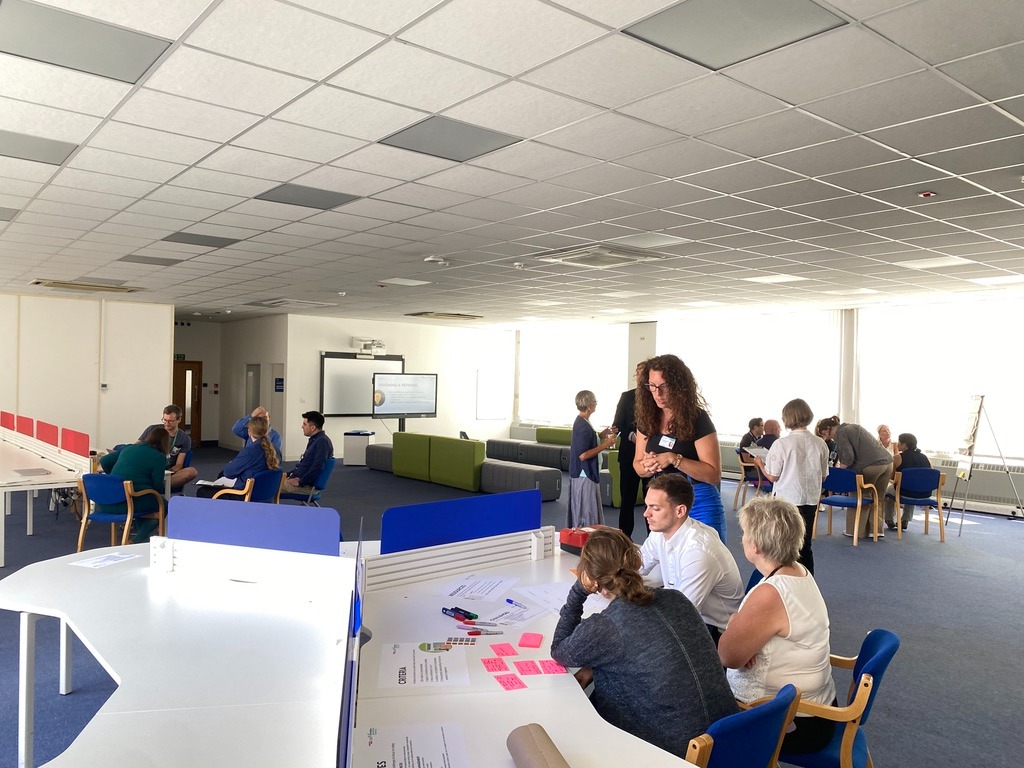
We next hacked solutions in person at Unipart House on July 13th. Participants honed in on specific problems that loosely fell under one of those three focus areas.
The prototypes from that hackathon were presented in an online meeting on August 5th 2026, in the presence of guests including Dr. Rebecca Beech, an expert in circular economy and influencing more sustainable consumption, Oxford Direct Services (ODS) Commercial Director Ben Dudley, and That’s TV Oxfordshire reporter Elizabeth Scott.

The hackathon required 4 hours of commitment from local businesses or individuals representing businesses. Our facilitator, Jo Zaremba (Blue Lemur Consulting), is an international specialist in participatory facilitation and economic inclusion strategies. In this work, she sought to balance a trade-off: it takes time to co-create plausible solutions, but many business people may not have the resources or flexibility to devote to making the solutions that will best serve them. They understand the potential to change supply chains into direct cost savings.
In this first series of its kind, we first identified the overlaps in waste challenges across business sectors, then quickly moved to filling gaps in infrastructure to either solve or prevent shared problems through new approaches to resource and waste stream management.
Read on to learn what businesses are telling us about the problems and solutions they share and how it will contribute to creating a Good Waste Charter for Oxfordshire.
What challenges do businesses face with waste?
In the first session, James Vance, Head of Sustainability at Unipart, shared expertise around what waste awareness infrastructure they have put in place on site, what the ‘waste hierarchy’ is, and how to implement some compliance measures in accessible and direct ways. After that, our participants were asked to split into groups and discuss the challenges they were facing in their own company with waste.
Though specific challenges within each of our participants’ entities differed, we quickly noticed themes across discussions in session 1 relating to balancing resources, waste stream management, and accountability. These themes became the focus areas moving into session 2, where participants were asked to focus on one specific problem (selected by the group) within one focus area to move into solution-focused thought.

What solutions might address some of those challenges?
In Session 2, we held an in-person meeting at Unipart House to address the challenges identified in the first session. Participants chose challenge areas to work on and split into groups to start prototyping plausible solutions. The session kicked off with a rapid fire brainstorm of ideas which were then assessed against criteria to ensure they were immediately implementable as part of the Good Waste Strategy.

In Session 3 the prototypes were presented for 5 minutes each to pitch solutions to the group.
Resource Evolution
The accountability group presented a solution targeting any businesses with material resources. The pitch aimed to “build the buy in” internally in order to increase accountability, doing this by bringing in experts to support businesses rather than relying on businesses themselves to do the heavy lifting. Presenting on behalf of the group was Bart Ashton, Chair of Zero Carbon Oxfordshire Partnership, who has experience steering an inclusive and sustainable local food strategy which, under the leadership of our WISH Partnership member Good Food Oxfordshire, recently earned Oxfordshire a Gold Award in food system sustainability.
This solution is intended to be considered by the highest-level decision-makers, who would understand that waste can cost up to 35% of overhead and savings can be realised by businesses not only in reduced disposal fees but also in value of recovered materials and efficiencies in operations. The solution suggested was development of “The Resource Evolution” project, experts who have proven solutions to waste challenges across sectors and can provide resources and tools that will specifically intervene to balance business aims with sustainable, circular goals: “You know your business, we know resources.”

Space for Waste
The balancing resources group presented a solution which highlighted that “Space for Waste” was essential moving forward. The presentation, led by Alec Puleston, Sustainability Coordinator at Greencore Homes, outlined the template for an immediately implementable manual that could support any business holding physical space or in the construction sector. The prototype included a template for planning meetings, suggested meeting content, bespoke design plans and efficiency mapping, implementation criteria, and finally the provision for a technical handover to ensure compliance.
Potential benefits of implementing the solution varied from cleaner layout to reduced costs to community co-benefits and increased education and awareness. Interestingly, the community engagement sessions Cherwell Collective ran in Spring also indicated resources to increase education and awareness as a primary solution to challenges they face.

In 2013, the Government revoked the ‘Site Waste Management Plan (SWMP) Regulations’ in England, which sought to encourage better waste management practices and improve the environmental performance of construction projects larger than £300k.
The ‘Space for Waste’ team’s idea builds on the SWMP ethos and seeks to support business by setting out a clear model for waste management on construction sites.
Oxshare
Our participants also set out to tackle very practical problems of what to physically do with waste that should never enter the waste stream. Emmanuel Deschamps, Sustainability Leader at ARC (Advanced Research Clusters (ARC) – Oxford & Harwell Campus) walked us through a prototype app: OxShare, which supports business-to-business sharing of resources, from raw materials to office supplies.
In this app, businesses would offer materials, find materials, and post requests, and would use AI to offer materials to the nearest neighbours first. Again, our solutions from community engagement sessions also suggested an app as the most straightforward way to keep items in circulation. We hope to launch this for Zero Waste Day in 2027 and are actively seeking sponsors to hire a part-time staff member and provide seed funds to make this solution a reality.

How do these solutions fit together?
In the final few moments of session 3, James Vance from Unipart reflected on the impressive presentations from the business groups. Vance highlighted the effective engagement and passionate discussion across sectors to shared challenges, and the common desire to find sustainable, circular solutions, coupled with an infectious enthusiasm that attracts attention and encourages involvement in this hackathon approach. His takeaway:
“Through enhanced collaboration, we can develop exciting, tangible solutions to the waste challenges that are impacting local businesses and the wider community.”
The Systems Challenge
Our focus on business engagement is rooted in an understanding of the systems challenge around waste in Oxfordshire. Much of the political focus on waste is around household waste, and that is primarily because the councils are responsible for and obligated to household waste, which only makes up 16% of waste nationally.
However, if we seek to move toward a circular economy and “good waste” practices, we need to address the systemic challenges that account for the bulk of waste, which is primarily generated by construction or commercial entities.

Founded as a “crisis” response unit, Cherwell Collective knows firsthand how the political system can delay plausible, simple, efficient solutions and tie the hands of very well-meaning and competent leaders.
We view the recent local government reorganisation as a key opportunity for local business leaders to support policy makers by driving the circular economy forward, supporting the implementation of solutions, and committing to a well-rounded, collaborative solution to waste challenges in Oxfordshire. If we have only one of the three derived solutions, it will not work, but if we each commit to manualizing and training accountability, balancing resources, and managing our waste streams through facilitating circularity directly between us, no one will be more uniquely equipped to address the challenge than our innovative business sector.
No solution can exist in a silo. These solutions must fit together like puzzle pieces and support one another.

“Attending Cherwell Collective’s waste management hackathon was a fantastic experience. Seeing dedicated practitioners present real-world challenges alongside innovative, actionable solutions, like a live app prototype, was truly inspiring. As an academic, having the opportunity to engage directly with industry leaders and share thoughts was invaluable. Cherwell Collective deserves great credit for bringing Oxfordshire’s waste management community together to collaborate.”
— Dr. Rebecca Beech, Senior Lecturer in Marketing, Oxford Brookes University
What’s next?
We are actively drafting a potential Good Waste Strategy to present to policymakers that consolidates solutions from our engagement sessions so far.
One of the most interesting revelations to date is that 2 out of 3 solutions offered by business and community members are shared: awareness building, and a resource sharing app.
As we draft our strategy, our focus is on meeting the needs of the diverse audiences that we have heard from in our consultations. We know these solutions have the highest chance of success, so they will be at the front of our implementation plan. The Charter will next be taken to local governments and local working groups for development and implementation.
This follows the model first set in place by Good Food Oxfordshire, beginning with their Good Food Charter, which led to the countywide food strategy now in place.
How to get involved
As we build the Good Waste Charter by compiling the learnings, needs, and ideas from our engagements with businesses, community members, and policymakers, we still seek your perspective and contributions. You may not have had the opportunity to participate in our Oxfordshire Waste Hackathon, but you may still care about the sustainability of your operations and reducing costs.
If so, please join us at our upcoming Wine and Winge about Waste evening for businesses. No topic is off limits, we just want to know what problems and solutions you have in mind and to introduce you to like-minded people looking to build more resilient infrastructure.

You can also contribute to the solution proposed by the Resource Evolution. We hope to build on our mapping waste streams consultation services for businesses to support this solution. If you want to learn more, fill in this form, map your waste stream, and let us support your resource evolution.
Use our resources and get involved in future engagement sessions
Don’t forget to visit cherwellcollective.com/good-waste-charter for up-to-date information. We hope to see you at an Engagement Session near you! Please increase your awareness by using our accessible resources:
Our thoughts on Kidlington’s waste dump
Why we promote circular practices


Join our drinks night for businesses
Wine and Winge About Waste with us this October to meet like-minded people and help us understand local needs around business waste.

Upcoming Good Waste Charter Events
Check the GWC webpage for up-to-date information on the next engagement sessions and more.

Dr. Emily Connally
Managing Director
Dr. Emily L. Connally uses lived experience from her childhood in rural New Mexico to guide her vision of communities living within the planet’s resources. Before founding Cherwell Collective, Emily was an experimental psychologist with expertise in how the brain learns and how people’s behaviour changes.
She uses that knowledge to create spaces that are truly open to all, where people from any walk of life can connect without judgement or pressure, and where people build the infrastructure they want and need for climate resilience.
More posts like this

Cherwell Collective Hosts Sustainable Fashion Show at UNESCO World Heritage Site Blenheim Palace
On 29 September, our third annual Sustainable Fashion Show came to Blenheim Palace, and what a night it was! It brought together 10 top-tier designers with ties to Oxfordshire, including…
 Hailey Larson
1st October 2026

Ringing in Sustainable Fashion Week 2026 with a Tap Social Clothes Swap
Saturday 26th September saw us join together with Tap Social Oxford to host another clothing swap as part of Sustainable Fashion Week. All together an impressive 129.58kg of clothing was…
 Victoria Russell
30th September 2026

Celebrating 25 years of CAG in Oxfordshire
Hosted at the historic St John’s College, Oxford, the evening brought together people and organisations connected by CAG’s work. It was a lovely opportunity to hear how the group began,…
Victoria Russell
23rd September 2026
Jump to a section
Article contents