Cherwell Larder: Thursdays 11am, and Fridays at 4pm while supplies last at WISH, 4 The Parade, Kidlington. Ask to join our WhatsApp group for regular updates on additional distributions.
Coming to a village near you: A riverside landfill
 Dr. Emily Connally
For any of you not living under a rock, you will have heard of a new landfill in Kidlington, illegally constructed in greenspace near one of Europe’s largest villages. This dump site has recently sprung a massive leak, not only in nationwide press, but also locally directly into the River Cherwell, (our inspiration in naming Cherwell Collective).
The River Cherwell is the second largest tributary feeding the mighty Thames River and as such supports hundreds of kilometres of life in our area. In the midst of a record breaking drought, where the sources of water in the Thames are becoming less and less reliable, the ramifications of this pop-up landfill are nothing short of catastrophic.
As you process the realities of this crisis, we want you to turn your emotions into action. We invite individuals, businesses, and organisations in Oxfordshire to commit to better waste behaviours.
Our Good Waste Charter is the first step forward in a path to inclusive, strategic policy that has the potential to prevent anything this horrific from happening again. Register your support for this approach and let us know how you’d like to be involved as we work with local groups to create and implement a strategic countywide solution.
Keep reading for:
- A brief summary of how current waste policy contributed to the crisis
- Our vision for Good Waste Policy
- A plea for waste infrastructure funding locally and nationally
- An invitation to action

Taxation Without Representation Makes a Mess
While the press coverage is more recent, the Kidlington Landfill is old news. Responsible residents reported concerns to local authorities (who did nothing) months ago. We will circle back to the helplessness of the system later. Before that, though, what caused this crisis to happen? Shortsighted policy: an April 2025 22% increase in landfill tax created a local black market for waste disposal by taxing essential infrastructure.
We wonder, who was represented at the table when that landfill tax was decided? Though construction accounts for 60% of waste and over 30% of landfills, that powerhouse is exempt from the landfill tax. Meanwhile, those with the least free capital end up footing their bill in full as costs trickle down to consumers (the over 3500 small and medium enterprises in Oxfordshire). A delay in planned increases to waste disposal taxes will buy some time to prepare, yet we are concerned that the majority of our local organisations are simply left out of these discussions.
Our business engagement around the Good Waste Charter indicates there is clearly a need for more inclusive decision making. While some taxes may be necessary, deciding who to tax and how much should be data driven and reflect representative consultation. The desire is for a solution to reduce waste through circular pathways and collaboration with the deliberate consideration of the consequences for all.
What is our vision for Good Waste Policy?
Our vision starts at the most fundamental level of the Cherwell Collective model: waste policy, like any other services, must be open to all.
Services and infrastructure must be accessible, consistent, and affordable.
In the case of our Kidlington landfill, infrastructure was not affordable, and the decisions made by a few local businesses to reduce overheads resulted in incalculable, irrecoverable costs for the taxpayer as well as the ecosystem.

Cherwell Collective leads the National Lottery Funded Waste Innovation Station Hubs (WISH) project, including laying the path to Good Waste Policy locally. On November 25th, 2025 The Good Waste Steering Committee agreed on a fundamental direction and basic framework moving forward, in the wake of this local disaster:
Good waste policy is seen as central to a cleaner, fairer, and more resilient Oxfordshire.
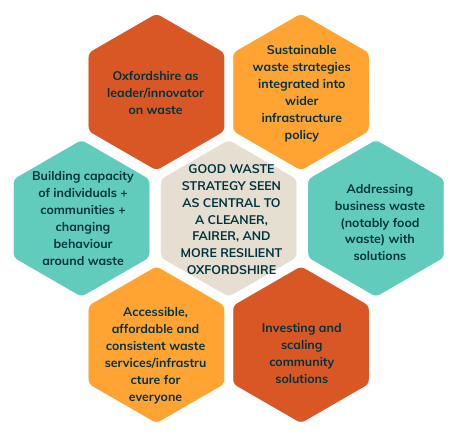
As a nationwide leader in waste practices for a decade, Oxfordshire has a responsibility to carry our legacy and push waste policy and practice from what is plausible to what is ambitious, groundbreaking, and if we are lucky, world-changing. Rather than focus on costs savings as the motivator, we must also invest and build capacity to change behaviour around waste.

We aren’t talking about teaching people how to sort recyclables. Household rubbish only accounts for 14% of the total waste in the UK, so impact is limited. Business waste is the bulk of the problem as well as the solution. The logic is simple:
- The best way to avoid a landfill tax is to avoid a landfill.
- The best way to reduce the carbon footprint of production is to recirculate in the original form.
The capacity we must build into the system is one which provides space, time, and energy to turn what would be trash into treasure.
Businesses overwhelmingly support a movement toward circular pathways and reuse chains , which is also central to nationwide strategy for waste reduction. However, how we fund that transition is not yet clear, though we think investment in existing community solutions is the best place to start.
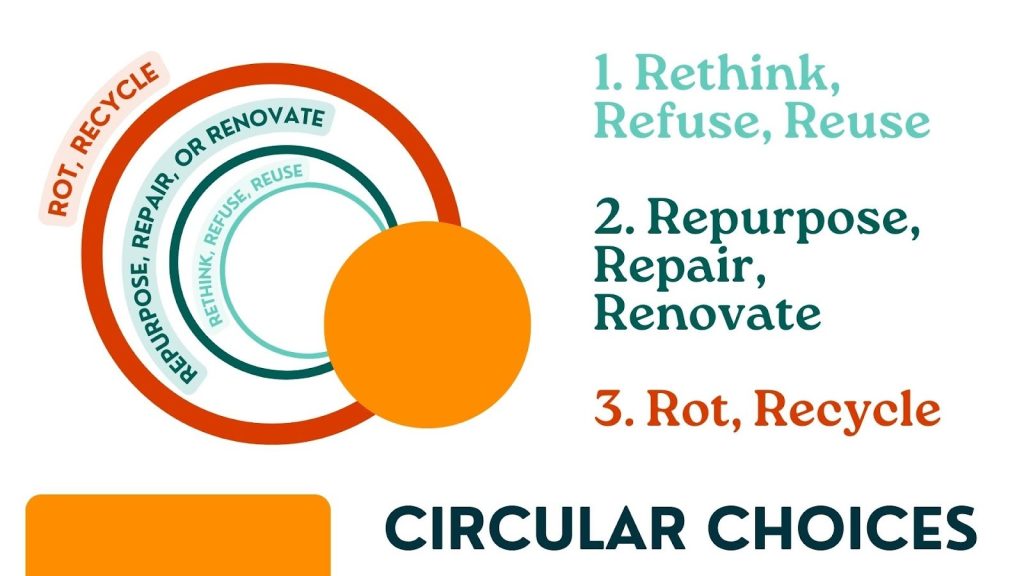
We believe it is critical to invest and scale community solutions in order to create the necessary infrastructure for low carbon waste solutions. Cherwell Collective’s Waste Innovation Station Hub (WISH) partners include Oxford Party Library, Oxford Food Hub, and SHARE Oxford, which all offer scalable, practical, community solutions. In the second year of the WISH project, our focus was on deeper consultation, reaching 500 more households than in 2024 and diverting over 640 tonnes of waste from landfill together. Relative to year 1 (420 tonnes of waste) WISH partners increased capacity for waste diversion by 40% relative to Year 1.
The WISH project keeps precious resources in use, understanding that waste is as much an opportunity as anything else. Waste presents potential for innovation and the more we reuse, the more resilient our economy.

There is more scope for community initiatives and local business to work together to create more circular practices and the Good Waste Policy will work to enable this. Our Steering Committee’s vision is focused on supporting different groups (communities, business, policy makers) to move Oxfordshire from a linear to a circular economy. We warmly welcome all sectors to engage with us to develop a strategy which will form into inclusive policy.
Policy has no teeth without the infrastructure to facilitate and enforce it
We firmly believe policy, particularly with associated taxes or fines, should not be in place without significant funding for best practice alternative solutions. We simply cannot tax people for doing the only thing they have an option to do, we must make the better alternative consistent, accessible, and affordable or we are simply kicking the can (literally) down the road, and in this case, into the river.
In the case of this criminal pollution of the River Cherwell we know the problem is not only infrastructure but enforceability. All the logical responsible parties for waste disposal violations were aware of the landfill at Kidlington for months, but in each case were unable to act. Local authorities across the nation are struggling with costs and operations, and are notably distracted by nationwide mandates for devolution.
Further, as we have diverged from the European standards which were protecting our environment, we have defunded the national organisations which could have addressed this disaster sooner. In the most recent press release indicating a cleanup will begin the government admits “The Environment Agency is not legally responsible for clearing illegal waste, and is not funded to do so.”
We must decide if we are committed to the climate crisis on our doorstep. If we wish to build climate resilience we must fund the infrastructure necessary at every step from the individual to the business, community to county to nation. Yes, it will be costly, but the alternative is simply unaffordable.
So far, the accountability for this action has been placed on one man, but we feel the lessons go back to the drafting table for these policies. The upcoming roll out of the Extended Producer Responsibility (EPR) will place additional financial burden and responsibility on businesses for packaging waste. Will we wait and pretend these burdens will have “unforeseen consequences for our community”? We foresee what will happen if businesses are not provided guidance, best practices, resources, and most importantly, accessible infrastructure. Do we have time to put some protections in place?
The restructuring of districts and counties (which are both local waste authorities) provides an opportunity for better waste policy and practice, but only if funded. We need to make it easy to do the right thing. Fund infrastructure to make the desired behaviour accessible and affordable, and automate its enforcement.
Waste is not a bioproduct, it is an untapped resource, with economic benefits that could save our planet.
You are invited to co-create Good Waste Policy
While we all recover from the shock of the assault on our beloved River Cherwell, we are not helpless.
Cherwell Collective invites you to join us in creating a long term solution to the waste problem, together. You can start anywhere:
Get involved with moving the Charter forward!
Fill out this form if you’d like to do any of the following:
- Engage with us on waste. What solutions do you want to see? In early 2026 we will start engaging our county around plastic waste and would LOVE for you to help us reduce plastic waste however works best for you. Join with others in your community – businesses, neighbourhoods, schools – to ideate, innovate and initiate actions to help reduce waste.
- Host an engagement session with your local organisation or group where we can discuss the problems and solutions together.
- Share your solutions. Tell us how you’re innovating to reduce waste in Oxfordshire. We are looking for case studies to share best practices. If something has really worked for you, fill out the above form so we can share your learnings and help others!
Or, consider other ways you can support this work:
- Visit our Waste Innovation Station Headquarters (WISH), where we offer exhibits and guidance on reducing your carbon footprint and resources for waste reduction
- Donate to fund our Good Waste Work in Oxfordshire.
- Map your waste streams using our google form. so we can understand local supply chains and how to streamline them together.

Join us in creating a long term solution to the waste problem
We are leading a Good Waste Charter process which aims to co-create and design waste policy in Oxfordshire with the public, community, businesses, and policymakers. Whether you’d like to be heavily involved or just let us know you support this idea, please fill out our brief form below.

Help us learn what's needed by mapping your waste streams
We need businesses to map their waste streams to help us gain a greater understanding of local waste streams, and guide us in our aim to inspire governments, the community, and regenerative enterprise approaches to implement sustainable changes. With good information like this, we firmly believe that a circular economy can not only save the planet, but also save businesses money, build community, and bring about exciting innovation.

Dr. Emily Connally
Managing Director
Dr. Emily L. Connally uses lived experience from her childhood in rural New Mexico to guide her vision of communities living within the planet’s resources. Before founding Cherwell Collective, Emily was an experimental psychologist with expertise in how the brain learns and how people’s behaviour changes.
She uses that knowledge to create spaces that are truly open to all, where people from any walk of life can connect without judgement or pressure, and where people build the infrastructure they want and need for climate resilience.
More posts like this

Cherwell Collective Hosts Sustainable Fashion Show at UNESCO World Heritage Site Blenheim Palace
On 29 September, our third annual Sustainable Fashion Show came to Blenheim Palace, and what a night it was! It brought together 10 top-tier designers with ties to Oxfordshire, including…
 Hailey Larson
1st October 2026

Ringing in Sustainable Fashion Week 2026 with a Tap Social Clothes Swap
Saturday 26th September saw us join together with Tap Social Oxford to host another clothing swap as part of Sustainable Fashion Week. All together an impressive 129.58kg of clothing was…
 Victoria Russell
30th September 2026

Celebrating 25 years of CAG in Oxfordshire
Hosted at the historic St John’s College, Oxford, the evening brought together people and organisations connected by CAG’s work. It was a lovely opportunity to hear how the group began,…
Victoria Russell
23rd September 2026
Jump to a section
Article contents