Cherwell Larder: Thursdays 11am, and Fridays at 4pm while supplies last at WISH, 4 The Parade, Kidlington. Ask to join our WhatsApp group for regular updates on additional distributions.
Climatarian Kitchen Turned Food Surplus into Fine Dining at Waterperry Opera Festival
12th September 2025
What comes to mind when you hear “food surplus”? Charity kitchens? Unsold supermarket stock? Crates of “ugly” fruit and vegetables destined for landfill? Rarely do we associate surplus food with dressed-up attire, candlelit tables, and an evening of world-class opera. Yet that’s exactly what happened this summer when Cherwell Collective’s Climatarian Kitchen partnered with the Waterperry Opera Festival to prove that sustainability and sophistication can, and should, go hand in hand, in a context that prides itself on being welcoming and accessible.
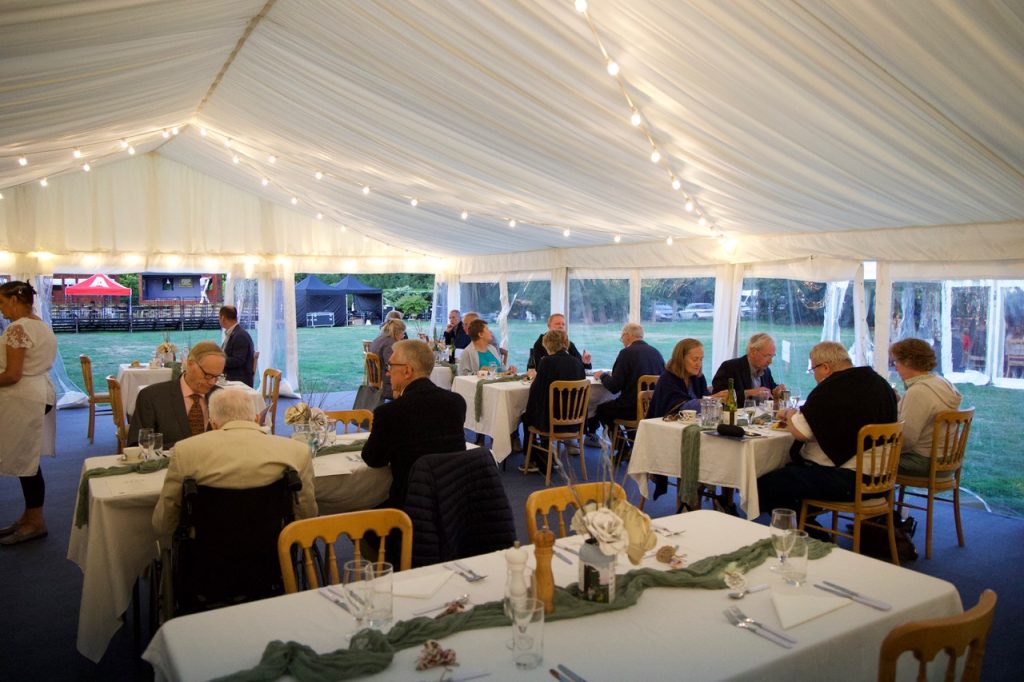
At Waterperry this summer, guests didn’t just listen to soaring arias and soak up the idyllic grounds of a country estate. They dined on dishes and picnic hampers made in part from surplus food, elegantly presented, and accompanied by a story about climate responsibility. Each menu item even came labeled with its Carbon Cost, inviting diners to reflect on the environmental impact of what they were eating while savoring a memorable cultural experience.
Elevating Surplus: A Fusion of Sustainability and Sophistication
At the heart of this collaboration lies a simple idea: food surplus doesn’t belong solely in the world of emergency relief and community larders. It can shine under evening lights, alongside both classical and contemporary opera, where plates and culture are paired with dressed-up attire.
During the festival, held outdoors at the Waterperry House and Gardens in Oxfordshire from 8 to 17 August 2025, Climatarian Kitchen offered two distinct experiences:
- Seated, three-course dinners served during the evening opera interludes at the Lawn Restaurant.
- Seasonal picnic hampers including both meat-inclusive or vegetarian options for casual dining among the gardens.
These options weren’t just delightful, they were also thoughtfully designed with sustainability front and center. Food options highlighted local and seasonal fruit and vegetables, including vegetarian options that have a lower climate impact than meat-based dishes. By employing food surplus, the entire scheme helped to reduce food waste. Food waste alone accounts for an estimated 8% of all greenhouse gas emissions globally.

Waterperry Opera Festival: Country-House Opera with Heart
Nestled in the scenic Waterperry House & Gardens in Oxfordshire, Waterperry Opera Festival is a shining example of country-house opera. It’s an enchanting mix of elegance, culture, and community in a countryside setting. Since its founding in 2017, the festival has built a reputation for making opera accessible, immersive, and inclusive, giving voice to emerging talents and inviting audiences of all ages to enjoy productions in a beautiful, relaxed environment. Over just seven years, it has produced 39 productions for more than 22,000 attendees, receiving praise for its youthful energy, innovation, and welcoming spirit.

The festival’s programming, ranging from glamorous stagings of Don Giovanni and Semele to family-friendly pieces like Winnie-the-Pooh’s Songbook, invites visitors to enjoy opera with leeway for picnics, lawn strolls, and rich immersion in the gardens. In this uniquely British tradition of relaxed elegance, country-house opera offers a perfect blend of culture and comfort.
Meet Cherwell Collective and Our Visionary Climatarian Kitchen
Cherwell Collective is a grassroots-led community social enterprise rooted in Kidlington, Oxfordshire, motivated by a deep commitment to sustainability, social equity, and community connection. Emerging during the COVID-19 pandemic to tackle food insecurity, we have blossomed into a multi-award-winning and nominated organization serving over 30,000 community members through our innovative projects.
Climatarian Kitchen promotes a radical concept that channels food surplus and seasonal local ingredients into delicious meals, fueling both environmental and social good. At most of our local pop-ups and our cafe in Kidlington, we operate on a pay-what-you-can basis. Our surplus cafe provides fresh, hot meals sourced from produce that might otherwise go to waste, while also offering a surplus market – Cherwell Larder Marketplace – for affordable ingredients, all of which aligns with reducing carbon footprints and combating food poverty
The Power of “Carbon Cost” and a Climatarian Diet
In the spirit of our programme’s mission, Climatarian Kitchen didn’t stop at simply serving tasty meals at Waterperry. We incorporated transparency into the very essence of each dish by calculating its Carbon Cost, expressed in car-mile equivalents.
For example, on our fine dining menu for Saturday, 16 August, to accompany a performance of Don Giovanni, patrons of the three-course seated dinner had a Main Course choice of either French Bean Stew or Coq Au Vin. The climate emissions of choosing the vegetarian stew were calculated as being the same as driving an average, ordinary petrol car in the UK for 4 miles. Meanwhile, one serving of the Coq au Vin created the same emissions as driving 14 miles. These tradeoffs were displayed for the starter, main course, and dessert for each night’s menu to help show the public the climate consequences of their food choices.

Each evening menu displayed the car-mile equivalent “Carbon Cost” of each dish using an odometer-style symbol next to each selection.
This approach is rooted in our broader mission: encouraging a Climatarian Diet, one that embraces seasonal, surplus, and local produce to dramatically reduce food’s climate impact. Food production accounts for around an estimated 24% to 30% of global greenhouse gas emissions—and choosing lower-carbon ingredients is a tangible way any of us can shrink our footprint.
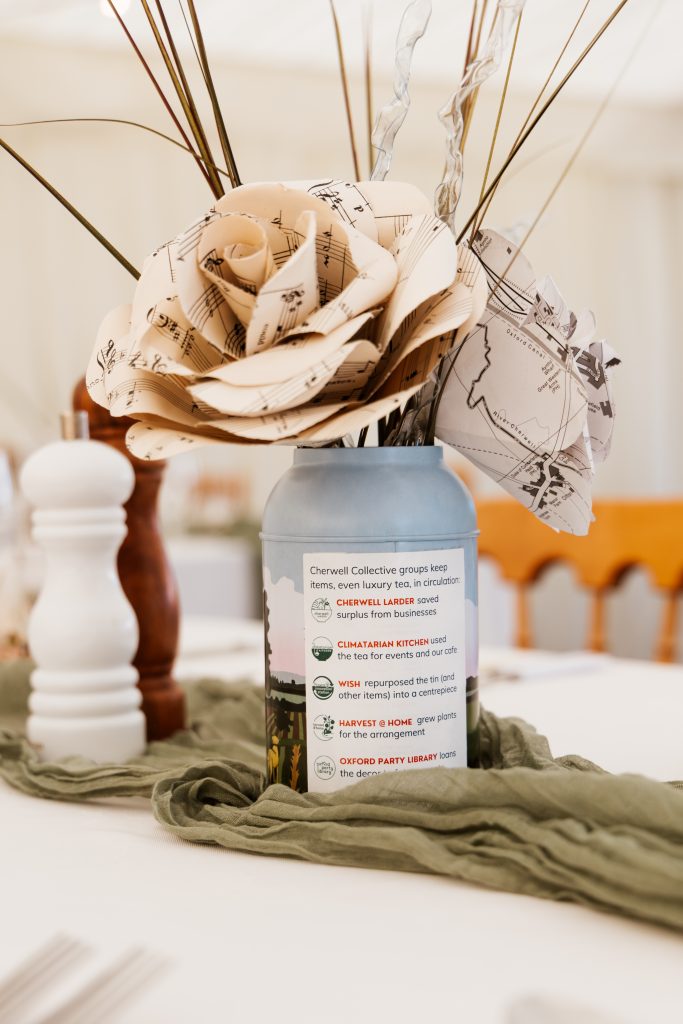
Cherwell Collective also leaned into circular-economy principles— not only reusing plateware contributed by other caterers rather than buying new— but also creating tableware from surplus and reducing resource strain in style. The tableware was repurposed from the evening’s tea tins into centrepieces featuring roses created out of sheet music and reusable floral displays made from plastic soda bottles. Seed bombs using surplus fabric acted as placeholders for guests. These centerpieces, table runners, and seed bombs will be used again at our upcoming Sustainable Fashion Show to illustrate the versatility of simple, elegant repurposing.
Defying Expectations With Elegance
Dr. Emily Connally, Director at Cherwell Collective, captured the essence of Climatarian Kitchen’s mission and the collaboration with Waterperry.
“We launched the partnership because we believe in changing people’s minds about what surplus means, and we wanted to support a festival that shares our ethos on inclusivity and accessibility.”

She went on to reflect on the scope of their ambition and the challenges the organization faced to provide a full range of catering services outdoors on an estate lawn.
“This was a real challenge for us… testing our skills in new and unknown areas like a mobile kitchen… helping to reduce stigma around surplus food. …we transformed trash to delicious, beautiful treasures and our diners agreed.”
This reflects a powerful cultural shift—surplus isn’t waste; it’s potential.
Highlights, Challenges, and What’s to Come
The feedback was overwhelmingly positive: “People thought our food was overall exquisite… the majority of our diners were thrilled, would come back again… and thought we provided an excellent, memorable experience,” Dr. Connally said.
But this project wasn’t without its learning curve. A few standouts from Dr. Connally’s reflections:
- Unexpected demand: We sold nearly four times as many hampers as the previous year, leading to shortages and even space issues in our mobile fridges.
- Packaging hiccups: Handles broke under strain, signaling a need for more robust solutions that provide sufficient durability for patrons moving about and picnicking outdoors.
- Surplus food choices: At our hamper station, despite encouragement to pick fresh salads over surplus packaged sweets, many guests still opted for the latter and were surprised by items “past best before.” Education around surplus remains key.
- Logistics of a mobile kitchen: Power outages and delays meant dishes like hot meals risked cooling prematurely and we sadly served some dry chicken rather than let our diners go hungry. Our plan for next time includes preparing more food on site, using slow cookers or hot-holding setups to avoid quality dips if the show runs behind or the power falters.
Dr. Connally ends on a hopeful note:
“We hope to do this again next year with some learnings around packaging and efficiency. Our final night had the best feedback of all, with people taking time to call me out of the kitchen and ask for recipes, what the “secret” ingredient in the quinoa was, and telling me the meal was perfectly seasoned and portioned. I think that improvement through the festival meant we learned as we progressed and can really elevate the quality next year even further.”

Why It Matters
This project demonstrates that:
- Surplus can be sumptuous. It’s possible to create a memorable, elegant dining experience rooted in sustainable principles.
- Transparency counts. Labeling dishes with their Carbon Cost raises awareness and helps people make informed decisions.
- Stylish sustainability is a powerful messenger. By serving haute cuisine in the context of an opera festival, Climatarian Kitchen turned an environmental message into an experience—not a lecture.
Cherwell Collective’s Climatarian Kitchen gave food surplus a dress-up moment, proving that reducing waste and climate impact doesn’t mean sacrificing flavor or elegance. Instead, it’s a path toward reimagining what fine dining can and should look like.

More posts like this

Cherwell Collective Hosts Sustainable Fashion Show at UNESCO World Heritage Site Blenheim Palace
On 29 September, our third annual Sustainable Fashion Show came to Blenheim Palace, and what a night it was! It brought together 10 top-tier designers with ties to Oxfordshire, including…
 Hailey Larson
1st October 2026

Ringing in Sustainable Fashion Week 2026 with a Tap Social Clothes Swap
Saturday 26th September saw us join together with Tap Social Oxford to host another clothing swap as part of Sustainable Fashion Week. All together an impressive 129.58kg of clothing was…
 Victoria Russell
30th September 2026

Celebrations for all at the BBC Make a difference awards
On Tuesday evening members of our team had the pleasure of attending the BBC Make a difference awards. Held at the Schwarzman centre for humanities, the event celebrated the amazing…
Victoria Russell
17th September 2026
Jump to a section
Article contents